
EDITOR’S NOTE
The following paragraph was taken from Scott Oden’s blog post titled “Appendix O: Scott Oden’s List of Heroic Historical Authors”.
“Heroic Historical fiction, defined by Charles Gramlich as a sub-set of heroic fantasy, is a very specific sub-genre. It’s the stuff one used to see in the pages of the pulps, especially Adventure and Oriental Stories; it’s the lurid paperbacks featuring gladiators or knights and swooning women from the 60s and 70s; in the modern era, it’s as rare as hen’s teeth. More often than not, it’s packaged today under the broad umbrella of historical fiction.”
As an afficionado of Sword & Sorcery fiction, I am very familiar with operating within the boundaries of narrowly defined nich subgenres. In fact, many of my most beloved works of fiction exist with the slim confines of niches-in-niches. Oftentimes, as many an S&S fan will attest, something existing in these sort of borders relies on a heary dose of gut feeling. One knows something is Sword & Sorcery, for example, by the way it sounds, the way it feels, by the way it makes the reader feel.
Heroic Historical ficition relies on much of the same intuition.
To me, the Heroic Historical excels at emphaszing the romance of lost time periods, even though they may have never existed as we like to imagine them. For example, and I believe Scott said this himself, is that Spartacus the movie is historical fiction, while Spartacus the TV series is Heroic Historical. That tracks with what the genre is in my head. Spartacus: Blood and Sand is far more concerned with being action-packed, sexy, and cool than any real sense of histocial acurracy.
ABOUT THE AUTHOR:
Scott Oden writes stuff. Usually, it’s stuff that has some ancient historical angle, like historical fiction; sometimes, he likes to flex his thews and hammer out a bit of sword-and-sorcery. And quite often, he writes opinionated blog posts on the Nature of Things. He’s written six books, to date. Men of Bronze (2005) and Memnon (2006), originally from a small publisher called Medallion Press; The Lion of Cairo (2010), which was the first book of a projected trilogy about Crusaders, Assassins, and a sword kind of like Elric’s Stormbringer, and The Grimnir Saga: A Gathering of Ravens (2017), Twilight of the Gods (2020), and The Doom of Odin (2023), all from St. Martin’s Press.
Scott’s also written a couple of introductions, a few short stories, and two pastiche stories featuring Robert E. Howard’s Conan: “The Shadow of Vengeance” (2019; reprinted in 2024), and “Conan Unconquered” (2019).
He would love to be a famous and beloved author, but he will settle for being “the guy who writes kinda like REH.”
THE PURPLE SHROUD
by Scott Oden

I.
THE STORM-LASHED waters of the Bosporus churned black beneath a stygian sky; in that chaos of wind and wave, Death crossed the narrow strait in a fishing boat.
Ioannes Tzimiskes felt the craft buck beneath him, its tarred hull groaning against the swells while a December gale shrieked like the Erinyes themselves. Lightning split the night; its stark glare revealed the walls of Constantinople rising from the European shore. His bearded jaw clenched with grim purpose, for this was no soldier’s homecoming; his life was forfeit if he was caught inside those walls. No, this was a reckoning.
“Keep a good eye!” the old soldier at the tiller called above the howling gale. “Yonder is the old landing where Genoese smugglers beached their goods. God grant us a light.”
And He did. A half-shuttered lamp guided them in.
Tzimiskes said nothing, his dark eyes fixed upon the city’s shadow-wreathed bulk. Somewhere within those walls dwelt Nikephoros Phokas — the White Death of the Saracens, scourge of Cilicia and Crete, and for six years Emperor of the Romans. Once, they had been companions, sharing wine and brotherhood on the frontier of empire; once, Tzimiskes had called him friend. But friendship, like empires, was a thing of seasons. Their spring had gone; their summer too. Autumn brought strife. Now comes winter, a time of endings, when old things die to make room for new.
The boat’s keel scraped stone; Tzimiskes rose, his hand falling to the hilt of his sword — no jeweled courtier’s toy, but honest steel that had drunk deep of foreign blood. He vaulted over the side and held the gunwale steady. The landing was little more than a shelf of wave-carved rock, slick with spray and treacherous in the storm’s half-light. Yet it served.
“My thanks,” he told the old soldier. “Upon your life, speak of this to no one.”
The old soldier nodded. “And upon yours, may your blade be true.”
With that, Ioannes Tzimiskes released the gunwale. The boat melted back into the welter of wind and wave, while above the city slumbered on, ignorant to the plans of powerful men. That half-shuttered lantern drew Tzimiskes to the relative shelter of a seawall gate. There, a figure emerged. Tall and gaunt, clad in coarse brown wool, Father Stephanos bore himself with the austere dignity of one who had wrestled with angels and found them wanting; his eyes held that peculiar fire which burns in men who mistake their own hatred for the wrath of God.
“My son.” The priest made the sign of the Cross. “God hides His eyes.”
“A foul night for foul business,” Tzimiskes replied. He studied the priest’s features in the lightning’s fitful glare. Here was another thread in the web that would strangle an emperor — for in Constantinople, no throne could stand without the Church’s blessing, and no blessing came without its price. “You bring word from His Holiness?”
“The Patriarch will recognize your claim and sanctify your coronation,” he said. “But only if certain conditions are fulfilled.” The monk stepped closer and, despite wind and rain and sleet, Tzimiskes caught the reek of incense clinging to his robes like spiritual armor. “She must be removed. Not exiled to some comfortable monastery where she might spin new webs of treachery. Removed entirely from this world and sent to face the judgment that awaits in the next.”
A chill touched Tzimiskes’s spine that had naught to do with the December wind. “Theophano? God’s teeth, man! The Empress isn’t–”
“She is an abomination!” The priest’s voice cracked like a lash, his composure slipping to reveal the fanaticism beneath. “A harlot who has made mockery of the sacred bonds of matrimony! You think the Church is blind to her adulteries? To the way she spreads her thighs for any man who might advance her station?”
Stephanos’s normally controlled features twisted with disgust. “She has corrupted the imperial household, transformed the Sacred Palace into a brothel, and made the purple itself a thing of shame. The people whisper that she practices the old magics, that she reads entrails and burns offerings to gods whose names were forgotten when Constantine raised his cross. Whether such tales hold truth matters not; the very rumors poison the empire’s soul like hemlock in a well.”
Lightning painted both men stark against the storm — the soldier come to commit regicide, and the priest who demanded something fouler still. “The Church will not sanction your rule while that creature draws breath,” Stephanos continued, his voice dropping to a whisper more menacing than any shout. “Remove her, and we proclaim you God’s chosen instrument. Spare her, and you shall face the same fate as him you’ve come to slay — alone, friendless, and damned.”
For a long moment Tzimiskes stared at the priest, feeling the weight of yet another choice settling upon shoulders already burdened with the night’s grim purpose. He had planned to marry Theophano, to further legitimize his nascent reign, but now . . .
This went beyond mere politics into realms where mercy became weakness and clemency, folly. The threat hung between them like an executioner’s blade. Tzimiskes found himself thinking of Theophano as he had last seen her — twenty-eight years old and in the full bloom of her beauty, eager for the power she believed their alliance would bring. Did she merit death for her ambition? For refusing to remain the silent ornament Byzantine custom demanded of imperial wives?
But an empire hung in the balance. Personal honor was a luxury he could no longer afford — if indeed he had ever possessed such a thing.
“Tell the Patriarch,” he said at last, the words tasting of ashes and betrayal, “I will see it done.”
Stephanos nodded, satisfied as a merchant who had driven a hard bargain. “God’s blessings upon you, then. Provided you are successful, his Holiness will have prayers of thanksgiving prepared.”
The priest turned and crossed through the seawall gate as silently as he had emerged, leaving Tzimiskes alone with his conscience and the sound of waves gnawing at stone. Above him loomed the palace walls, and beyond those walls waited the man who had once been his friend — the friend he must kill before sunrise
But first, other business demanded his attention. In the depths of the city, conspirators waited in sanctuaries older than Christ’s promise, their own grievances sharp as daggers. Each man nursing his private hatred, each convinced that removing one mad emperor would somehow heal an empire’s deeper wounds.
Fools, perhaps. But useful fools, and Ioannes Tzimiskes had learned long ago that useful men need not be wise ones.
Silently, he followed the priest . . .
II.
THE SUNKEN PALACE earned its name from the forest of columns that upheld its vaulted roof — a stone grove where shadows bred like living things in the guttering candlelight. None were precisely uniform; they’d been scavenged, stolen from the porches of pagan temples and the porticos of fallen palaces when Justinian’s masons carved this wonder from the living rock. Here, in the belly of Constantinople, in the shadow of the Hagia Sophia, where the empire’s lifeblood pooled in eternal darkness, four men stood in a circle around a sputtering flame, their faces half-hidden in dancing shadows.
These were no common cutthroats bought with silver, but the flower of Byzantine nobility — men whose bloodlines stretched back to the city’s founding, dynasts and sons of dynasts. Yet for all their breeding, they bore themselves like conspirators since time immemorial: heads bent together, voices hushed, eyes bright with that fearful zeal that seizes men when they plot against their lawful lord.
Their candlelight flickered; beyond their circle of illumination, melting sleet and rain sluiced into the cistern, disturbing the water’s black surface. Other splashes spoke of things that dwelt in the city’s buried depths, far from the sun’s cleansing touch.
“God take this foul weather,” muttered Leo Balantes, his patrician features creased with worry. “If Tzimiskes cannot cross from the Asian shore . . .”
“Then we must proceed without him,” said the old general, Michael Bourtzes, though his scarred visage betrayed his unease. “The game has begun, friends. The Empress has played her part, this night — the gate will be unbarred whether he comes or not.”
Young Nikephoros Komnenos shook his head. “You know as well as I that this cannot succeed without him. The eastern themes will follow Tzimiskes, but they’ll not rally to any of us. We lack his reputation, his connections among the stratiotai.”
“More than that,” added Balantes grimly. “Without him, this becomes mere murder. Kill Nikephoros without a successor in place, and by dawn the Varangians will have crowned some other puppet. The Patriarch will bless it, the Senate will ratify it, and by week’s end all our heads will decorate the Hippodrome’s walls.”
The eunuch Basil Lekapenos, his soft features pale in the flickering light, wrung his hands. “Then we must abandon this foolhardy plan. There is still time! Let us return to our beds and pretend this night never was.”
“And wake tomorrow with swords at our throats?” Bourtzes’s laugh held no mirth. “If we betray the Empress tonight, she will betray us upon the morrow, if only to save her own neck. No, friends. We are committed now. If Tzimiskes does not come–“
A voice emerged from the darkness. “I am here.”
The conspirators snarled and cursed, hands dropping to the hilts of swords and knives as Ioannes Tzimiskes stepped into the flickering circle of light. Even in the cistern’s shadows Tzimiskes’ presence commanded attention — not through physical stature, for he stood shorter than most, but through that aura of controlled violence he projected. Here was a man who had commanded armies and broken kingdoms, whose name was whispered in fear from the Danube to the Euphrates.
“Ioannes!” Bourtzes clasped his old companion’s arm. “We feared you lost–“
“I am not so easy to kill,” Tzimiskes flashed a brief smile, then studied each face in turn, reading the mixture of relief and apprehension in their eyes. “Do any of you doubt what must be done?”
“We do not,” said Balantes quietly. “But this enterprise stands or falls with you. None of us can command the loyalty you do, none can legitimize what we do tonight.”
Tzimiskes nodded slowly. “I have wrestled with this burden for weeks. The crown corrupts all who wear it — I have seen this truth written in Nikephoros’s transformation from hero to tyrant. Yet if not me, then who? If not now, when?”
“The themes await word,” Komnenos said. “The dispatches are prepared, the messengers ready to ride at dawn. They need only know whose standard to follow.”
“And the Patriarch has given his blessing,” added Tzimiskes. “The pieces are in place.” The conspirators were quiet for a long moment, listening to the drip of water in the ancient cistern, the distant rumble of thunder above. When Tzimiskes next spoke, his voice carried the weight of an irrevocable decision. “Then let God’s will be done. I accept what Fate and Necessity have thrust upon me. Before another dawn breaks, I shall claim the purple — or we shall all be dead.”
“God’s will be done.” The conspirators murmured in agreement; as they prepared to depart, however, Basil Lekapenos stepped forward, his face even paler than before.
“My lords,” he said, his voice barely above a whisper, “I must crave your pardon. I find myself . . . unwell. This dampness, this foul air . . . I fear I would be more hindrance than help in what follows.”
The others exchanged glances. They had all seen Lekapenos’s episodes before — the shaking hands, the sweating, the way he would collapse at moments of great stress.
“Go,” Tzimiskes said quietly. “Return to your chambers. Speak to no one of this night, and when morning comes, act surprised with the rest.”
Lekapenos bowed gratefully and melted back into the shadows, leaving four men to complete what five had begun.
“Coward,” Komnenos muttered.
“Perhaps,” said Tzimiskes. “But as head chamberlain he perhaps serves our cause better without blood on his hands. Come — the night grows old, and a reckoning awaits.”
The die was cast; the Rubicon crossed. Above them, Destiny spoke in roars of thunder and jags of lightning . . .
III.
THE PALACE GARDENS lay shrouded in winter’s embrace, their sleet-rimed paths threading between ancient cypresses that swayed like mourners at a funeral. Four shadows moved among the trees; four cloaked wraiths who followed routes known to lovers and assassins, the secret ways by which the mighty were brought low since the world was young.
The postern gate stood ajar as promised, its bronze hinges gleaming wetly in the storm’s dying light. Beyond lay corridors where the tread of a hundred generations had worn marble smooth as silk, where mosaics of long-dead Caesars gazed down with painted eyes that had witnessed the empire’s rise and would yet see its fall.
They encountered but one obstacle in their passage: a yellow-haired Varangian whose wine-heavy sleep made him easy prey for Komnenos’s blade. The Norseman died in silence, his life’s blood joining the countless stains that had sanctified these stones across the centuries.
“They will find him at the morning watch,” Bourtzes whispered as they arranged the corpse in a shadowed alcove. “By then, the deed will be done.”
Now they stood before the imperial apartments themselves, those ivory doors carved with eagles that had watched over Caesar’s sleep since Constantine raised his New Rome from the bones of Byzantium. Light seeped beneath the threshold; someone stirred within.
Tzimiskes pressed his ear to the door, listening with a hunter’s patience. From beyond came footsteps — measured, deliberate, pacing with the restless energy of a caged predator. He knew that rhythm as well as his own heartbeat. Nikephoros walked thus when the weight of campaigns pressed too heavily upon his shoulders, when sleep fled and only movement could quiet his tormented thoughts.
“He is awake,” Tzimiskes breathed. “And alone.”
The conspirators arranged themselves like wolves preparing to strike, weapons concealed but ready. In moments they would face the man who had been friend and commander, brother-in-arms and bitter enemy. There would be words — there always were — but steel would have the final say.
Tzimiskes drew breath, tasting blood and destiny upon his tongue, then pushed open the door . . .
Emperor Nikephoros II Phokas stood before a great marble-framed window that looked out over the Sea of Marmara, his tall form silhouetted against the storm-wracked sky like some titan contemplating the world’s destruction. Gone were the purple robes of state, replaced by a simple white tunic that hung loose upon his gaunt form. His feet were bare upon the cold marble, yet there was naught vulnerable in his bearing; even in undress, he carried himself with the terrible dignity of one born to command.
At their entry he turned. Tzimiskes felt his breath catch like a blade between his ribs. The years had carved their passage deep into his old friend’s face, the strain and sleepless vigils etching lines across his craggy brow. His black hair and beard were shot through with silver, and his flesh hung slack upon bones that seemed too large for their covering.
But it was his eyes that told the tale. Those dark orbs that had once burned with ambition’s flame now held only weariness and a terrible species of knowing, as if he had looked upon the face of eternity and found it wanting.
“Ioannes,” he said simply, his voice carrying neither surprise nor fear, only the flat acceptance of a man who had exhausted his capacity for shock. “I wondered when you would come.”
The words hung in the charged air like thunder’s rumble. Behind Tzimiskes, the other conspirators shifted with the nervous energy of hounds scenting blood, hands moving to weapons not yet drawn. This was not how they had envisioned the confrontation’s beginning.
“You were expecting me?” Tzimiskes asked, stepping deeper into the chamber while his confederates moved to block the exits. “Name my betrayer!”
Nikephoros smiled, but there was no mirth in the expression—only the bitter amusement of a player who had finally seen through the game’s pretenses. “No one betrayed your little conspiracy. I simply know the man.”
Steel scraped against marble as, from the wide window sill, Nikephoros took up his sword. It was no ceremonial weapon, but the cavalry saber he’d carried before donning the purple. That naked blade, pitted and notched from use, had seen service in a dozen campaigns; it had drunk deeply of the blood of Turks, Bulgars, and Greeks. Tonight it thirsted anew.
“Your madness must end!” said Bourtzes, his own blade half-drawn from its sheath. “Ioannes! Do not tarry!”
Nikephoros fixed the former general with a stare that would have withered a lesser man. “Madness? You old fool, I am weary unto death. Weary of ruling men like you, who smile while they sharpen their knives. Weary of fighting wars for an empire that counts coins while its enemies gather strength. Weary of sleeping cold while my wife spreads her legs for any man with an inch of ambition. Men like good Ioannes, here.” The crude words struck like daggers, each syllable weighted with the accumulated bitterness of years. “She promised you the throne, did she not, as though it was hers to give? Whispered honeyed lies of how much better you would prove than some old despot who neglects her needs. Did she speak of love? Did she claim to see in you the man I once was?”
Heat rose in Tzimiskes’s cheeks, but his voice remained steady as hammered steel. “This is not about Theophano. This concerns Constantinople itself—an empire bleeding its life away beneath your rule.”
“My rule?” Nikephoros laughed, the sound echoing off marble walls like the cackle of Furies. “You think I rule anything? I am a prisoner in this palace of ghosts, surrounded by grasping courtiers and scheming nobles who would sell their own mothers for an ounce of gold and a taste of power. Every decree I issue is questioned, every strategy debated, every victory forgotten before the blood has dried upon the field.”
He began to pace once more, his blade catching the lamplight as he moved like some restless spirit seeking succor. “Do you know what I was doing when you arrived? Watching the city burn—not in flesh, but in my mind’s eye. I can see it written across the heavens like a prophecy: Constantinople in flames, the empire carved between Bulgarian wolves and Arab jackals, the last Caesar dangling from his own palace walls. That is Byzantium’s destiny when strong men like us are gone.”
“Then abdicate,” Tzimiskes said. He reached up and unclasped his sodden cloak; the fabric fluttered to the floor. His other hand sought the worn hilt of his sword — a long straight spathion, its hilt wrapped in leather and silver wire, that hung from a baldric at his left hip. “Let someone else bear the burden if you find it too heavy.”
“Someone like you?” Nikephoros ceased his pacing and faced his former friend with eyes that held the weight of ages. “You’re a simpleton if you think the purple won’t corrupt you as it has corrupted every man who has worn it since the days of Constantine the Great. Look at yourself, Ioannes! You stand there panting like a cat in heat at just the thought of ascending to my throne! You covet my possessions, my wife, and you tell yourself the convenient lie that you plan my murder for the good of the people! For Byzantium’s salvation!”
Tzimiskes lifted his sword’s baldric clear of his shoulder and slowly drew the blade from its scabbard. “There is truth in what you say, Niko,” he said, using the informal name of the emperor’s youth. “I am not driven entirely by altruism. Nor by duty, desire, or love. But what benefits me also benefits the whole of the Empire. Fear has transformed you into the very caricature of a man we once scorned — a weak-willed fool who sees enemies in every shadow and trusts not a living soul.”
“Trust?” Nikephoros’s voice took on the hysterical edge that had become increasingly common in recent months. “You speak to me of trust while plotting my death? You cuckold me, suborn my generals and my courtiers, and then dare lecture me?” The emperor thrust his sharp-boned chin at Tzimiskes. “Nay, Ioannes. You are wrong. I do not see enemies everywhere — I see them precisely where they are . . .”
Nikephoros struck without warning; his saber hissed through the incense-laden air, seeking Tzimiskes’s throat in a reckless blow that would have ended all their plotting in a single heartbeat. Only the latter’s reflexes, honed on the bloody fields of Asia, saved his life and his ambitions. He swayed out of the saber’s path.
“Adiuta Deus!” Tzimiskes roared, and the duel was joined.
Spathion met saber in a ringing clash of steel that sent shivers through the palace stones. Nikephoros danced back, his bare feet slapping against the cold marble. Tzimiskes leapt after him, scarred face twisted into a rictus of killing joy. Here was no courtly contest, fought by ancient rules with room for courtesy like some gentleman’s disagreement. No, this was naked savagery, and it played out as it had since Cain fought Abel—brother against brother, blood against blood, steel seeking the soft places to steal life in crimson streams.
The blades met again with a screech that set teeth on edge. Steel rasped and slithered; breath exploded in gasping draughts that misted in the chamber’s chill; lips peeled back in snarls of rage that belonged more to wolves than men. The Emperor’s saber carved silver arcs through air thick with the scent of winter’s damp and incense.
Nikephoros fought like a man possessed, the Furies lending their weight to blow after hammering blow. His saber moved in wild, sweeping cuts that would have cleaved an ox in twain—overhead strikes that split the air with an eerie whistling, horizontal slashes that sought Tzimiskes’ ribs — a butcher’s cleaver seeking bone. Spittle flew from his lips as he pressed forward, forcing his one-time friend back step by grudging step across the marble floor slick with their mingled sweat.
But Tzimiskes was the anvil to Nikephoros’ hammer, and anvils do not break—they shape the steel that strikes them. Each ringing blow he deflected with subtle shifts of his wrist, turning killing strokes into glancing contacts that sparked but did not bite. Each devastating cut that would have opened him from throat to groin he caught on the curved guard of his spathion, the shock of impact traveling up his arm like lightning but finding no purchase in muscle hardened by twenty years of war. Cuts that would have separated his head from his shoulders he answered with reckless laughter and nothing more—the mad mirth of a man who had looked Death in the face so often they had become old friends.
The Emperor’s blade whispered past Tzimiskes’ ear, close enough that he felt the wind of its passage ruffle his hair. In response, he twisted inside the arc of the next strike, his own point seeking the gap between Nikephoros’ ribs. The Emperor threw himself backward, the spathion’s edge drawing a thin red line across his chest. Blood dark as wine welled in the lamplight.
Nikephoros gnashed his teeth in rage; his breathing came harder now, each inhalation a conscious effort as the fury that had sustained him began to ebb. The weight of years pressed upon his shoulders—years of campaigns in the Bulgarian mountains, of nights spent in armor while lesser men slept in silk, of victories bought with other men’s lives and defeats paid for with his own flesh.
Up and down the chamber they danced to Destiny’s tune, from the locked door where Tzimiskes’ conspirators waited with drawn blades to the window where December wind set the silk curtains billowing like funeral shrouds. Against the sweat-and-blood slickened marble, each step was a calculated risk that might end in a fall and a blade between the ribs.
Tzimiskes was content to let the Emperor lead this deadly pavane, content to be the patient stone against which the waves of imperial fury broke themselves. His spathion moved in tight, economical patterns—parry, riposte, withdraw—each motion designed to steal another ounce of strength from Nikephoros’ increasingly desperate attacks. He had learned patience in the Armenian highlands, fighting mountain bandits who knew that the first to tire was the first to die.
The Emperor’s next cut came from the right, a diagonal slash aimed at Tzimiskes’ neck. The younger man ducked low, feeling steel part the air where his head had been, and came up inside the Emperor’s guard, his spathion’s point driving toward the heart. Nikephoros twisted away at the last instant; Tzimiskes felt his sword’s tip gouge a furrow along the Emperor’s ribs instead of punching through them. The movement might have saved Nikephoros’s life, but it cost him his balance.
He stumbled, his left foot sliding on the slick marble, and for a heartbeat his guard dropped. In that heartbeat, Tzimiskes struck. His blade described a flickering backhand arc that terminated in a spray of blood as it opened Nikephoros’ sword arm from wrist to elbow. The saber clattered to the floor, ringing like a tocsin of doom.
The Emperor staggered back against the wall, his right hand pressed to the wound while blood seeped between his fingers like wine from a cracked cup. His chest heaved with the effort of drawing breath, and his eyes—those dark eyes that had looked unmoved upon a thousand battlefield corpses—now held the terrible clarity that comes to dying men in their final moments.
“God wills it,” Tzimiskes said quietly, his spathion steady in his hand. The blade’s edge caught the lamplight, throwing dancing shadows across the chamber walls like the souls of the dead seeking passage to whatever realm awaited them beyond the veil.
Nikephoros sagged against the wall, his wounded arm hanging useless at his side. “God?” he gasped, each word bought with effort, “you think God wants you to be emperor?”
“If He did not, would our positions not be reversed? Would I not be the one about to die, Niko?”
The older man gave a bitter laugh. “Death comes to all, Ioannes. The purple you crave is but a shroud that walks upright for a time, nothing more.” He pushed himself up and away from the wall, swaying, his bearing regal despite the blood that painted his chest and limbs. “Strike then, if you think that is the will of God. But know that you buy your throne with the coin of betrayal, and that debt will come due when you least expect it.”
Tzimiskes stepped forward, his blade’s point a handspan from Nikephoros’ chest. The chamber was silent save for the whisper of wind and sleet through the window.
“Any last words, my friend?”
Nikephoros smiled then—not the rictus of fear or rage, but something almost serene. “Remember, Ioannes,” he said. “Remember that you, too, are mortal.”
The spathion took him through the heart with surgical precision, sliding between ribs to find the seat of life with a soft sound like silk tearing. Nikephoros’ eyes widened for an instant, then went dark as winter pools. He slid down the wall to sit upon the marble floor, his head tilted forward on his breast.
Tzimiskes withdrew his blade. In the lamplight, Nikephoros Phokas, the White Death of the Saracens, looked smaller somehow, diminished by life’s flight until he seemed less like the terrible tyrant who had broken the Bulgarian kingdom than just an old man who had lived too long and trusted the wrong people.
The other conspirators approached, their faces showing the peculiar mixture of triumph and horror that follows successful treachery.
“God be praised,” said Leo Balantes, his voice hushed as if he stood in a church rather than a charnel house.
Tzimiskes nodded. “Send word to the Patriarch,” he said. “Tell him it is done.”As his confederates hurried to obey, Tzimiskes remained alone with the dead. Nikephoros sat against the wall in his puddle of cooling blood, his sightless eyes reflecting the lamplight like black mirrors. The wind through the window set the curtains dancing, and for a moment it seemed as if the Emperor’s shade lingered in their movement—watching, waiting, remembering the words he had spoken about debts coming due.
Tzimiskes felt the familiar weight of steel against his palm. Tomorrow he would be crowned Emperor of the Romans, would wear the purple and hold the scepter that commanded from the Danube to the Euphrates. But tonight he was still only a man who had killed his friend for a throne, and the weight of that deed would follow him all his days.
IV.
DAWN CAME LIKE a thief to Constantinople, stealing across the storm-scoured waters of the Golden Horn; fingers of gold and crimson painted the city’s ancient stones in shades of blood and glory. The tempest had passed, leaving behind air sharp as Byzantine steel and a sky washed clean of winter’s malice. From the palace gardens where emperors had walked in ages past, Ioannes Tzimiskes—no longer merely a general but Caesar-elect of the Romans—watched the sun climb above walls that had withstood Goths and Huns, Arabs and Bulgars, yet had fallen this night to the silent siege of ambition.
Around him the machinery of power ground into motion with the inexorable patience of fate itself. Messengers bearing the purple seal would soon gallop toward the themes, their saddlebags heavy with proclamations that would transform last night’s murder into this morning’s acclamation. In the Senate house, bought men prepared speeches that would legitimize what steel had accomplished. The Patriarch readied prayers that would sanctify regicide as divine will.
Yet for all the morning’s golden promise, one piece of theater remained unplayed.
A whisper of silk brocade against stone announced another’s approach across the frost-limned grass. Theophano came to him as she had in those secret autumn nights when their conspiracy was yet young—beautiful still despite her thirty years, her raven hair unbound and her violet eyes bright with the fever of triumph realized. Behind her walked Zoe, her lady-in-waiting, a woman of similar height and coloring who had served as more than mere attendant in the games of palace intrigue.
“The wheel turns at last,” she said by way of greeting, a smile playing at the corners of her mouth. “We who were vassals yesterday wake as conquerors of the world. You must tell me all that transpired, my love. I–”
“There is no time,” Ioannes said. Something in his eyes caused her finely-drawn brow to furrow. “One final performance remains before the throne will be safe for your son. Listen to me: step into yonder arcade and change clothes with your lady-in-waiting.”
Suspicion flickered across Theophano’s patrician features. “Why?”
“There is no time for questions. Quickly! Zoe, go with your mistress . . . before the wags of the court assemble.”
“Ioannes, I don’t understand—”
“Theophano, beloved,” Tzimiskes’s voice hardened. “Do as I command. As you trust me with your son’s life, trust me now with your own.”
Perhaps it was the memory of their shared nights, or perhaps simple habit of obedience to male authority, but both women complied. In the shelter of the marble arcade, its arches overgrown with evergreen foliage, they exchanged robes—Theophano’s imperial purple for Zoe’s simpler garb, jeweled slippers for plain leather, the trappings of power for those of servitude.
When they emerged, Tzimiskes nodded approvingly. In the dawn’s uncertain light, with their similar builds and coloring, the deception was complete enough to fool casual observers.
“The diadem,” he commanded, and from the shadows stepped the eunuch, Basil Lekapenos, bearing the crown of the Empress on a cushion of silk. At Tzimiskes’s gesture, Lekapenos placed it upon Zoe’s brow, transforming the lady-in-waiting into the semblance of an empress.
“Now what?” Theophano asked, her voice tight with growing unease.
Instead of answering, Tzimiskes drew his dagger. In one fluid motion, he drew Zoe into a startled embrace and drove the dagger home.
Zoe’s eyes widened in shock, a rush of bloody froth staining her lips as she tried to speak. Tzimiskes released her, and she collapsed to the frost-rimed earth; the imperial diadem rolled away to lie gleaming in the morning light like a fallen star.
Theophano’s scream died in her throat, choked off by horror and understanding in equal measure. “You bastard! What have you done?”
“I have purchased a future for your son,” Tzimiskes replied, wiping his blade clean on the dead woman’s robes. “And for you. The Church demands its price, and that price must be paid in full view of witnesses.” He nodded at the white-faced eunuch, the unimpeachable head chamberlain of the imperial palace. “He will swear he saw me execute the Red Empress with my own hand.”
“But why—?”
“Theophano Augusta died this morning, justly executed for her crimes against the sacred bonds of marriage.” He studied her pale face with something that might have been compassion. “But Anastaso—the name you bore before your first marriage—Anastaso can live. She must live. There is an estate on the island of Prinkipo, a quiet place where noble ladies retire from the world’s burdens. You will go there, not as a prisoner but as penitent, and there you will wait.”
She stared at him as if seeing a stranger. “Wait for what?”
“For your son to reach his majority. For the empire to stabilize under my rule. For the day when a woman named Anastaso might safely return to court as . . . an advisor to the emperor. The boy will need guidance, and I shall need someone who understands the game as well as you do.”
The audacity of it struck her silent. He was offering exile instead of death, separation instead of the grave—but exile nonetheless, a living death that would tear her from everything she had known.
“And if I refuse?”
Tzimiskes glanced meaningfully at Zoe’s still form. “Then you join her in truth, and your son grows to manhood without either parent to guide him. The choice, as ever, is yours.”
The sound of approaching footsteps echoed across the garden—courtiers and officials drawn by Theophano’s scream, come to witness the aftermath of imperial justice. They would find what they expected: the new emperor standing over his predecessor’s wife, having meted out the punishment that Church and tradition demanded.
“Decide quickly,” Tzimiskes murmured. “Your mourners approach.”
Theophano—Anastaso—pulled the simple cloak tighter around her shoulders and stepped back into the shadows of the overgrown arcade. When the courtiers arrived, they found only an emperor and a corpse, and the glittering crown that would soon grace a worthier brow.
The wheel had turned, as it always did. One dynasty lay dead, another had been reborn, and the empire groaned onward toward whatever destiny the Fates had spun for it in their eternal loom.
In the distance, a bell began to toll—whether for the dead or the newly crowned, none could say.
From the Chronicle of Michael Attaleiates, composed in the fortieth year of the reign of Basil the Bulgar-Slayer:
In the sixth year of his reign, on the feast of Saint Lucia, Nikephoros II Phokas was slain in his palace by Ioannes Tzimiskes and certain accomplices. Tzimiskes ruled for six years, proving himself a capable commander in the field and a just administrator in the palace. Yet those who knew him marked a change in his character after his coronation. Where once he had been open-handed with his trust, he became suspicious of all save his closest kinsmen. Where once he had been quick to mercy, he grew harsh in his judgments. Some attributed this to the corrupting influence of power; others claimed he was haunted by the shade of his predecessor.
He died in the sixth of his reign, some say of fever contracted in the Mesopotamian campaigns, others of poison administered by a spurned mistress . . .
THE END.
Return Friday, September 29th for a riveting tall tale from the Missionary’s Mistake, “QUEEN OF THE COMMUNIST CANNIBALS”!
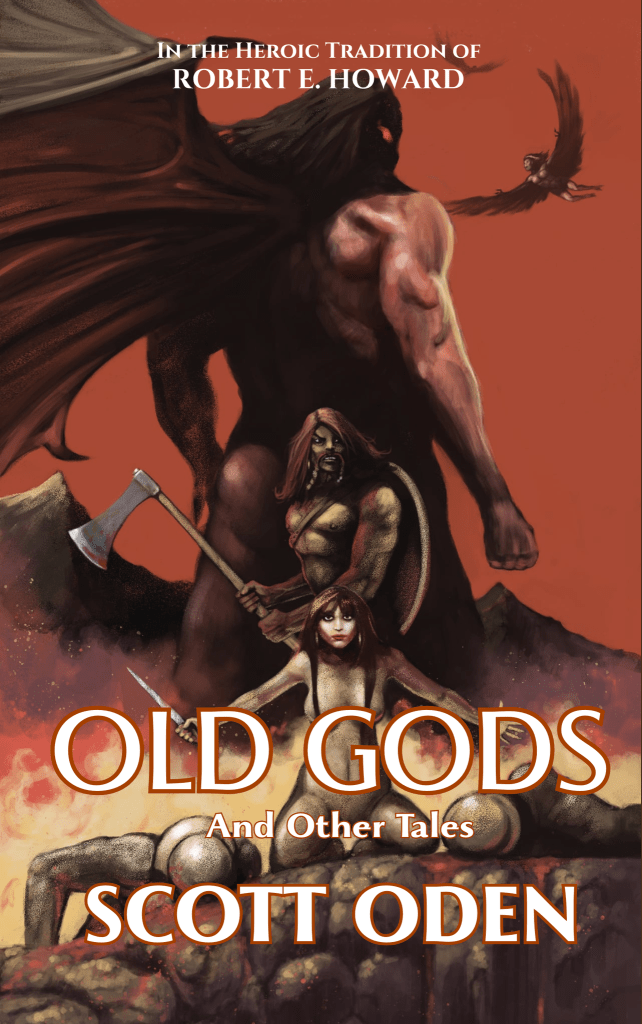
“OLD GODS & OTHER TALES” by Scott Oden is Available TODAY! Click the link below!


 Cliffhanger! Magazine
Leave a reply to Publication Day! – Scott Oden Cancel reply